From Pledge to Practice: Why Every Leadership Commitment Now Needs a Management System
From Pledge to Practice: Why Every Leadership Commitment Now Needs a Management System
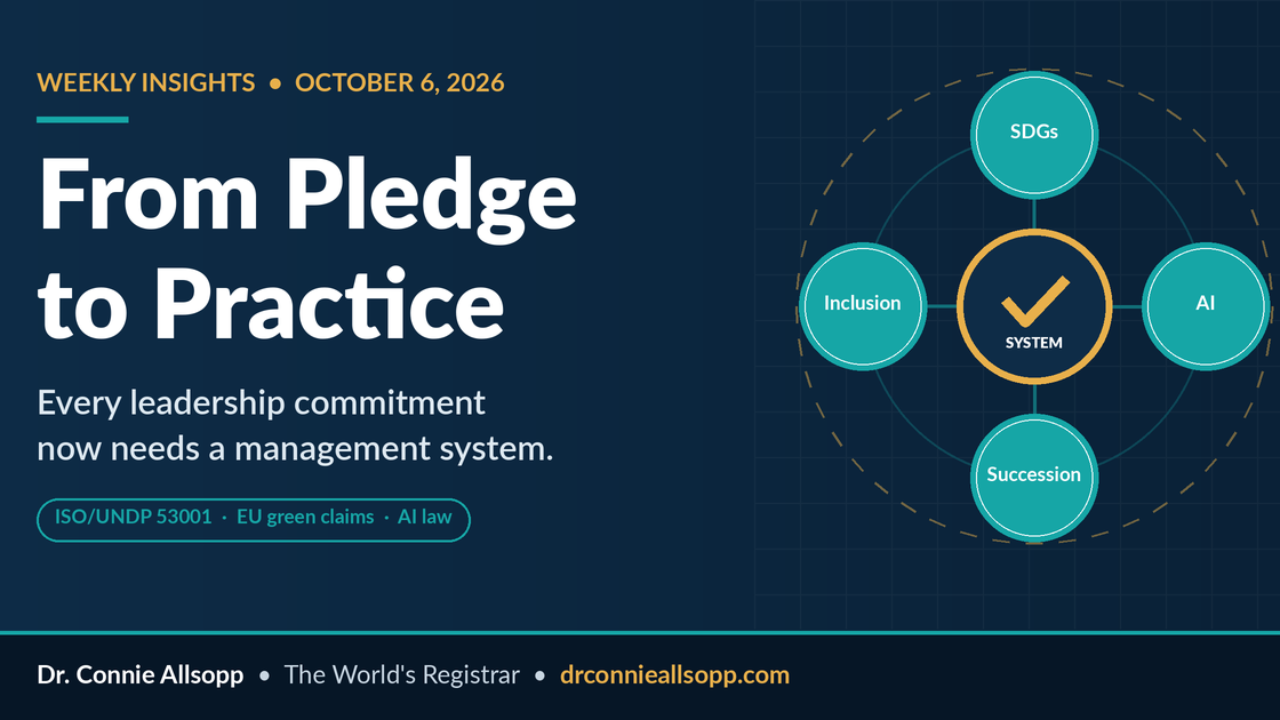
ISO/UNDP 53001, new EU anti-greenwashing rules and Connecticut's new AI law all landed within days of each other. Together they send boards one message: sustainability, AI and inclusion now need operating systems, not mission statements.
I have spent my career helping leaders turn big shifts into systems their organizations can actually run. Last week, it felt as though the rest of the world arrived at the same conclusion.
Across sustainability, AI and succession, the distance between what organizations promise and what they can prove is shrinking fast. That is uncomfortable for some, and a genuine opportunity for leaders willing to build the plumbing behind their purpose.
This week's spotlight: the SDGs finally get a management system
On 28 September, live from the ISO Annual Meeting in Paris, ISO and the United Nations Development Programme launched ISO/UNDP 53001, described as the world's first International Standard giving organizations a structured, requirements-based management system for integrating the Sustainable Development Goals into strategy, governance and operations. It is designed to work alongside ISO 9001 and ISO 14001, to let organizations focus on the SDGs most relevant to them, and to remain useful beyond the 2030 Agenda.
Here is why I think this matters more than the headlines suggest. For a decade, the SDGs have lived mostly in the glossy pages of annual reports: colourful icons with very little operating discipline underneath. A management-system standard changes the question leaders are asked. It is no longer “Which goals do you support?” but “Who owns them, how are they measured, and how do you improve?” That is a governance question, and it belongs in the boardroom.
The theme of this year's ISO meeting was “Building trust in a changing world.” That is exactly the point. Trust is not built by declarations; it is built by systems that make commitments visible, measurable and accountable. And because ISO members can adopt the standard nationally, global and Asia-Pacific leaders should expect it to become a shared language across supply chains, investors and governments.
What should leaders do now? Start with three moves. First, audit the SDG claims you already make and match each one to real evidence. Second, choose the three to five goals that are genuinely material to your business, and give each an executive owner. Third, plug them into the management systems you already run, such as quality, environment and, increasingly, AI under ISO/IEC 42001, rather than building another silo. And remember that several SDGs are people goals: gender equality (SDG 5), decent work (SDG 8) and reduced inequalities (SDG 10) put inclusion squarely inside your sustainability system.
Also on my radar
Sustainability & ESG
Europe's new anti-greenwashing rules (the ECGT directive) entered into application on 28 September, banning unverified generic claims such as “environmentally friendly” and requiring future climate pledges to carry a detailed, public implementation plan with independent verification. Closer to home, a consultation on Canada's sustainable finance taxonomy found about two-thirds of respondents opposed a proposed oil-and-gas “Abatement” category, with many calling for credible entity-level transition plans.
Connie's take: From Brussels to Ottawa, a credible transition plan is becoming the passport to green capital.
AI governance
A Federal News Network commentary (2 October, written by an Appian executive) cites an HBR Analytic Services and Appian study finding that 92% of organizations agree autonomous AI agents need rules-based guardrails, yet fewer than half have put them in place. Meanwhile, Connecticut's CART Act began taking effect on 1 October, including a requirement that employers filing WARN layoff notices disclose whether reductions relate to AI or other technological change.
Connie's take: The space between agreeing on guardrails and building them is precisely where governance risk lives.
Inclusion, equity & accessibility
The same CART Act makes clear that using automated employment-decision tools is no defence to a discrimination claim, while anti-bias testing may be weighed in an employer's favour. And October is National Disability Employment Awareness Month in the U.S., with the theme “Celebrating Value and Talent.”
Connie's take: If AI touches hiring or promotion, equity is now an engineering requirement: test it, document it and own it.
Leadership & trust
New Gallup research (24 September) finds that only one in five employees trust their leaders “a great deal” to use employee data responsibly: 40% of engaged employees, versus just 4% of the actively disengaged. Only 19% say anyone at work has talked with them about the data their organization collects.
Connie's take: Transparency is a leadership behaviour, not a policy page. Have the conversation.
Succession planning
Fortune reports that Goldman Sachs' board has discussed naming president John Waldron as its next CEO, with David Solomon potentially moving to executive chair; the bank says there is no definitive timeline. A Russell Reynolds adviser quoted in the piece warns that such roles must be “extremely well defined.”
Connie's take: Succession is a system too: define the outgoing leader's role, set the timeline, and plan for the leaders who aren't chosen.
What this means for you
- Run a “promise audit.” List every public commitment you make (SDGs, net zero, inclusion, responsible AI) and the system and evidence behind each. Anything without both is a reputational liability.
- Build one integrated architecture, not four silos. Quality, environment, AI (ISO/IEC 42001) and now SDG (ISO/UNDP 53001) management systems share a common logic. Align ownership, metrics and review cycles across them.
- Put people at the centre of AI governance. Bias-test any AI used in people decisions, disclose where it is used, and talk openly with employees about the data you collect.
- Treat succession as governance, not a name in an envelope. Maintain emergency, planned and long-term succession plans, and define roles and timelines before the transition begins.
About Dr. Connie Allsopp
Dr. Connie Allsopp is the Founder & Strategist of The World's Registrar, holds a doctorate in leadership education, and speaks to leaders around the world, including at the Horasis Asia Meeting. Based in Victoria, BC, she helps leaders and entrepreneurs turn big shifts (AI, succession, ESG and inclusion) into systems their organizations can actually run.
Let's turn your commitments into a system
Whether you are strengthening AI Governance, building a Succession Plan, embedding IDEA (Inclusion, Diversity, Equity & Accessibility), designing ESG & Sustainable Systems, or growing as a modern leader, I would love to help. Explore coaching and programs at drconnieallsopp.com or email me directly at [email protected].
Sources
- ISO and UNDP launch world's first International Standard to advance action on the Sustainable Development Goals — ISO, 28 Sept 2026
- New EU Anti-Greenwashing Rules Enter into Force — Mark Segal, ESG Today, 28 Sept 2026
- Stakeholders Strongly Oppose Inclusion of Oil and Gas in Canada's Sustainable Finance Taxonomy — Mark Segal, ESG Today, 1 Oct 2026
- Government has a trust problem with AI. Here's how to address it. — Jason Adolf, Federal News Network, 2 Oct 2026
- Connecticut's CART Act: New Comprehensive AI Regulation for Employers, Social Media, Chatbots, and Synthetic Content — Zachary Soto, PAG Law, 11 June 2026 (provisions effective 1 Oct 2026)
- US Department of Labor announces 2026 National Disability Employment Awareness Month theme — U.S. DOL ODEP, 26 May 2026 (observance: October 2026)
- Employee Data Use: One in Five Trust Leaders a Great Deal — Andy Kemp & Ryan Pendell, Gallup, 24 Sept 2026
- John Waldron is 'one of the most non–Wall Street people' you've ever met—but he's in line to be the next CEO of Goldman Sachs — Morgan Chittum, Fortune, 1 Oct 2026
Hashtags
#Leadership #AIGovernance #ResponsibleAI #ESG #SDGs #ISO53001 #Sustainability #SuccessionPlanning #Inclusion #Accessibility #BoardLeadership #DrConnieAllsopp
Stay connected with news and updates!
Join our mailing list to receive the latest news and updates from our team.
Don't worry, your information will not be shared.